
Apapacho: preventing violence and promoting child development in Colombia
Lab director Jorge Cuartas, along with lab members Juliana Borbon, Luciana Becassino, and collaborators from Fundación Apapacho, Innovations for Poverty Action, and the Colombian Institute for Family Welfare (ICBF), have published a new article in Child Abuse & Neglect: “The Apapacho Early Childhood Violence Prevention Parenting Program: A Mixed-Methods Pilot Evaluation.”
This paper presents findings from a mixed-methods pilot evaluation of Apapacho, a violence prevention parenting program developed through a research-practice partnership between researchers, practitioners, and public sector institutions in Colombia. The program is designed to be culturally grounded, low-cost, and scalable within existing early childhood services.
Why Apapacho?
Violence against children remains a major public health and human rights challenge worldwide. In Colombia, physical punishment and psychological aggression toward young children are still common, with important consequences for development, mental health, and long-term wellbeing.
Colombia has made major policy commitments to prevent violence against children, including a legal ban on physical punishment and national strategies focused on family support and early childhood development. Yet despite strong policy frameworks, universal parenting programs that explicitly address violence in the home remain limited.
Apapacho was developed to help close that gap. Rather than creating a standalone intervention, the program was designed to be integrated into existing government early childhood services (ICBF’s Modalidad Familiar and Modalidad Institucional), which already reaches hundreds of thousands of families. This approach aims to maximize feasibility, sustainability, and long-term scale.
The program focuses on strengthening parenting capabilities through:
- responsive caregiving and early stimulation
- emotional awareness and self-regulation
- non-violent discipline strategies
- supportive caregiver relationships
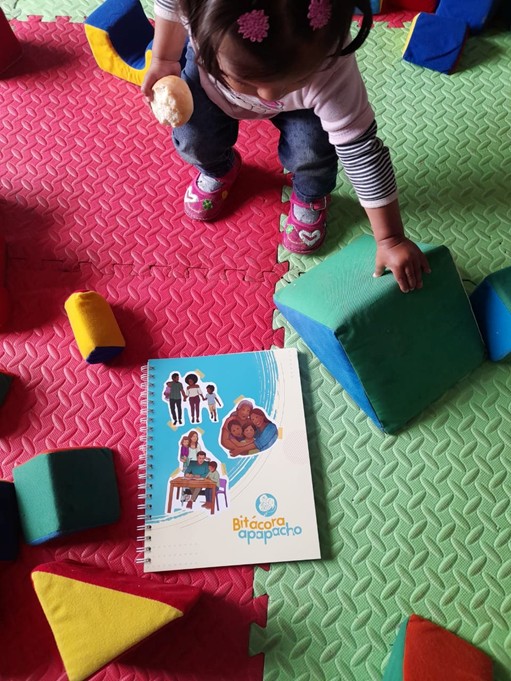
Sessions were delivered weekly in group settings, supported by WhatsApp reminders and a culturally adapted family journal that helps families apply strategies at home.
How Was the Program Evaluated?
The study used a convergent parallel mixed-methods design, combining quantitative and qualitative data collected at the same time and integrated for interpretation. Outcomes included caregivers’ reported engagement in responsive caregiving and stimulation practices, mental health and well-being, and use of non-violent discipline and violent punishment. Data were analyzed using a difference-in-differences approach and thematic analysis.
What Did the Study Find?
Responsive caregiving and stimulation
Participation in Apapacho was associated with improvements in caregivers’ beliefs and practices related to responsive parenting. Specifically, the program led to:
- an increase in positive beliefs about responsive caregiving (β = 0.17)
- an increase in caregivers’ engagement in early stimulation activities such as play, reading, and shared interaction (β = 0.19)
Qualitative findings reinforced these results. Many caregivers reported better understanding their children’s developmental needs, spending more intentional one-on-one time together, and experiencing closer emotional relationships.
Mental health and well-being
Quantitative analyses didn’t show statistically significant short-term effects on caregiver mental health or parenting stress. However, qualitative findings suggested perceived improvements in emotional awareness, self-regulation, and social support networks among caregivers.
Child discipline and routines
Apapacho was also associated with meaningful changes in how caregivers think about and manage child behavior:
- reduced approval of violent discipline (β = −0.12)
- increased use of non-violent discipline strategies such as redirection, communication, and emotional co-regulation (β = 0.12)
Although quantitative estimates for reductions in physical punishment and psychological aggression were not statistically significant in the short term, qualitative findings showed that many caregivers described concrete changes in how they respond to children’s behavior. Parents reported communicating more clearly, praising desired behaviors, helping children regulate emotions, redirecting attention instead of punishing, and making deliberate efforts to avoid hitting.
Why These Findings Matter
The results suggest that Apapacho is a promising strategy for promoting positive parenting and preventing violence against children, particularly because of how it is designed to function within existing public systems.
Several features make the program especially relevant for large-scale implementation:
- integration into services families already attend
- low-cost materials and delivery
- cultural adaptation through local research and collaboration
- feasibility for implementation by trained facilitators
These characteristics distinguish Apapacho from many resource-intensive programs developed in high-income contexts, which are often difficult to scale in settings with limited resources.
Read the full paper here: https://www.sciencedirect.com/science/article/pii/S0145213426000700